Prepreg and filament winding: how a carbon pole is made
The prepreg and filament winding methods behind our carbon awning poles, their material values and quality control.
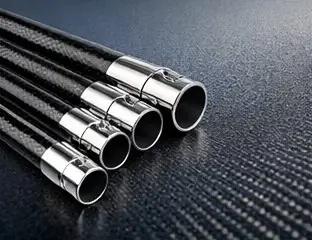
“Carbon” is not the same in every product. A pole’s strength comes from fibre orientation, the resin system and the manufacturing method.
Prepreg
Prepreg is carbon fibre pre-impregnated with a controlled amount of epoxy. Because the resin ratio is fixed, strength is consistent part to part. Our slim poles use prepreg with a 120 °C glass transition temperature (Tg), so the structure does not soften on a hot deck.
Filament winding
For heavy poles, fibres are wound onto a mandrel at set angles. Angle-oriented plies reduce bending, torsion and fatigue from wind and vibration. The method covers diameters from 40 to 350 mm and lengths up to 12 m.
Material values
- Density: 1.55 ± 0.05 g/cm³
- Tensile strength: 900–1200 MPa
- Elastic modulus: 70–110 GPa
- Operating temperature: −40 °C to +110 °C
Finish and quality
Poles are finished in gloss or matt epoxy or UV-protective lacquer, made at our Izmir plant under an ISO 9001 quality system. In R&D we run tensile, impact and ballistic tests with university partners.